Gelagen Official Website Blog Who The Vitamin D Row Actually Reaches
Who The Vitamin D Row Actually Reaches
Ten micrograms of vitamin D is a small, fixed number on a printed panel. Whether it is a meaningful contribution or a rounding error depends entirely on circumstances the label cannot see: where a person lives, how much of their skin is usually covered, and how old they are.
The row, printed exactly as the panel states it
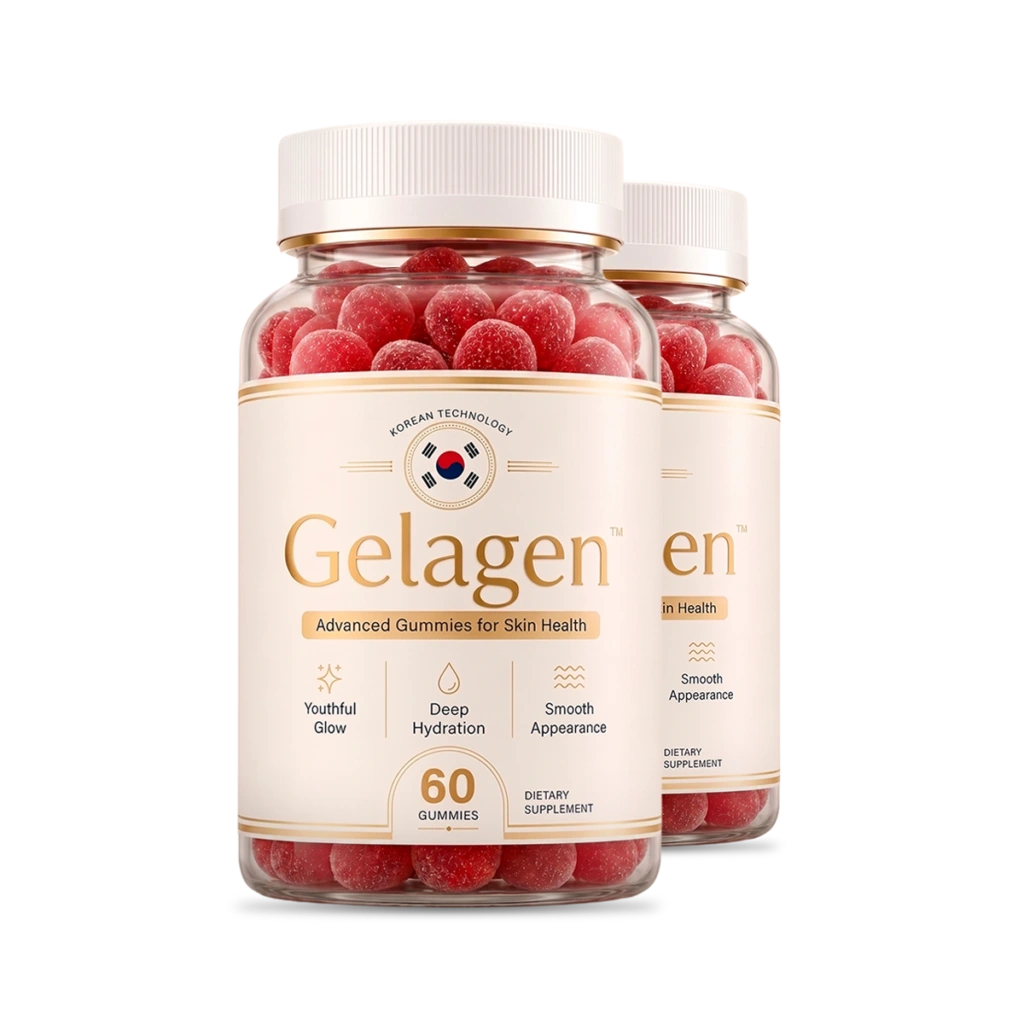
Gelagen’s own supplement facts panel prints one vitamin D row: cholecalciferol, 10 mcg per two-gummy serving, listed as 50% of the Daily Value. The panel also carries the two reference figures a reader needs to place that number: an RDA of 15 mcg for adults up to age 70, and an upper limit of 100 mcg. Ten against fifteen is two-thirds of the adult RDA from one source among however many a person’s day already includes, and it is worth saying plainly that this article is not trying to recompute that fraction in more decimal places. The arithmetic is not the interesting part of a vitamin D row. The interesting part is that vitamin D is unusual among the panel’s fourteen rows in one specific way: most people are not supposed to need a supplement or a food source for all of it, because skin is supposed to make a meaningful share of it on its own, from ordinary daylight. Whether that manufacturing process still runs well for a given person is the actual question a printed milligram figure cannot answer, and it is the question this piece tries to answer instead.
No other post in the Gelagen journal discusses vitamin D. This one exists because the row deserves a piece on its own terms: not how it compares to a percentage column, but who, specifically, is more likely to be leaning on it.
How skin makes vitamin D, and what has to go right
The process itself is well described in the research literature and summarized in the NIH Office of Dietary Supplements’ health professional fact sheet on vitamin D. Skin holds a compound called 7-dehydrocholesterol. When ultraviolet B (UVB) radiation from sunlight reaches it, that compound converts to previtamin D3, which the body then turns into the vitamin D3 the rest of the body uses. It is a genuine synthesis pathway, not a metaphor: the sun is, for most of human history, the primary source of vitamin D, and food sources are comparatively few and comparatively small (fatty fish, egg yolks, and fortified products like milk and some cereals being the short list).
The fact sheet is also specific about how easily that pathway is interrupted. It names season, time of day, length of day, cloud cover, and smog as atmospheric and situational variables that change how much UVB actually reaches skin. It names the amount of melanin in skin as a variable that changes how efficiently the UVB that does arrive gets used. And it names aging as a variable that reduces the skin’s own capacity to run the reaction in the first place. None of these are edge cases. Between them, they cover most of a population: everyone has a season, a latitude, a skin tone and an age, all at once, and all four either help or work against cutaneous synthesis on any given day. A single fixed number on a supplement label, 10 mcg, is added to whatever that combination happens to produce, and the combination is doing most of the actual work of deciding whether a person is short.
Latitude and season: the geography of the problem
The ODS fact sheet discusses latitude directly, because UVB intensity is not constant across the globe or across the calendar. The sun sits lower in the sky the farther a location is from the equator, and a lower sun angle means the UVB photons that trigger the skin reaction travel through more atmosphere before they arrive, and more of them are absorbed or scattered before they reach the ground. The practical result, as the fact sheet notes, is that in northern parts of the United States and in similar latitudes, winter sunlight is often too weak, at too low an angle, for cutaneous synthesis to proceed at any useful rate at all, no matter how long a person stands outside. A person in Minneapolis in January is not failing to make vitamin D because they went outside for too short a time; the geometry of the problem does not allow for it that day, regardless of how the day is spent.
This is a seasonal effect as much as a geographic one. The same city that makes some vitamin D from June sunlight in twenty minutes may make close to none from a December noon, and the changeover happens gradually enough that most people never notice the month their own supply effectively stopped. A supplement row that holds steady at 10 mcg every day of the year does not know the season either; it is the one part of the day’s vitamin D intake that does not fluctuate with the calendar, which is precisely what makes it more likely to matter in the months when the skin’s own contribution has quietly dropped toward zero.
Skin tone: the same sun, a different yield
Melanin, the pigment responsible for skin tone, absorbs UVB. That is part of its biological function; it is also the reason the ODS fact sheet lists increased skin pigmentation as a factor that reduces the skin’s vitamin D yield from a given amount of sun exposure. Two people standing in the same sunlight, for the same length of time, at the same latitude, do not necessarily make the same amount of vitamin D, because more of the melanin-rich skin’s UVB exposure is absorbed by pigment before it can drive the synthesis reaction rather than after. This is a documented physiological difference, not a claim about anyone’s general health, and the ODS material states it as a straightforward mechanism rather than a risk score.
What it means for a printed 10 mcg row is that the same fixed number reaches different people from different starting points. For a person whose skin synthesizes vitamin D less efficiently from a given amount of daylight, a food or supplement source is doing proportionally more of the total daily job than it would for someone whose skin synthesizes it more readily under the same sun. The row on the panel does not change; what changes is how much of the day’s total vitamin D was ever going to come from somewhere other than that row.
Indoor lifestyles and sunscreen: the modern variable
The ODS fact sheet also lists the use of sunscreen among the factors that reduce cutaneous vitamin D synthesis, alongside clothing that covers most of the skin and, more broadly, time spent indoors. Sunscreen is designed to absorb or reflect UV radiation before it reaches skin, which is exactly the property that also blocks the UVB the skin would otherwise use to make vitamin D. None of this is an argument against sun protection, which the same public health apparatus recommends for entirely separate and well-established reasons around skin cancer risk. It is simply the other half of the same fact: a behavior that protects skin from UV exposure also reduces the one UV-dependent process this particular row on the label is meant to supplement.
Indoor lifestyle is the more silent version of the same variable. Office work, remote work, school schedules built around indoor classrooms, and simply living in a climate where people spend most of daylight hours inside all add up to less skin exposed to less sun for less time, independent of season or latitude. A person who is rarely outside during the hours when the sun is high enough to trigger synthesis is, in effect, experiencing a permanent version of the northern-winter problem described above, whatever the actual latitude on the map says. For that person, a food or supplement source of vitamin D is not a backup to a system that is otherwise working; it may be close to the only source running at all.
Age: the skin's own capacity declines
The fourth factor the ODS fact sheet names is aging itself, independent of season, latitude, skin tone or lifestyle. The concentration of 7-dehydrocholesterol, the compound in skin that UVB converts into previtamin D3, declines as skin ages. Put plainly, older skin exposed to the identical sunlight as younger skin, at the identical latitude, with the identical amount of pigment, produces less vitamin D from it, because there is less of the raw material available for the reaction to run on. This is why age-related decline in cutaneous synthesis is treated by the ODS material as a distinct factor from the other three, rather than a restatement of them: it operates through a different mechanism, one specific to the aging of the skin itself rather than to geography, pigment, or habit.
This factor compounds with the others rather than replacing them. An older adult who also lives at a northern latitude, who also spends most of the day indoors, is accumulating several independent reasons for reduced cutaneous synthesis at once, not one. None of those reasons individually requires a supplement to exist as a solution; they simply describe why, for that particular combination of circumstances, a fixed daily source that does not depend on sunlight, season, or skin condition is more likely to be doing real work rather than sitting on top of a supply that sunlight was already providing.
Putting the circumstances together
None of the four factors above is a diagnosis, and none of them alone says anything about any specific person’s vitamin D status; that can only be established by a blood test ordered by a clinician, not by a label or an article. What the ODS material supports is a narrower, population-level point: the circumstances under which cutaneous synthesis is most likely to be reduced are well documented, they are common, and they overlap in real people rather than existing as separate categories.
| Factor | What changes |
|---|---|
| Latitude and season | A lower sun angle means more atmosphere for UVB to pass through; at higher latitudes, winter sunlight may not support synthesis at any useful rate. |
| Skin pigmentation | Melanin absorbs UVB, which reduces the amount available to drive the synthesis reaction from the same sun exposure. |
| Indoor lifestyle and sunscreen | Both reduce the UVB that reaches skin; time spent indoors is a direct reduction in sun exposure itself. |
| Age | The skin's store of 7-dehydrocholesterol, the compound UVB converts, declines with age, independent of the other three factors. |
Put together, the profile that emerges is someone who is older, lives at a northern latitude, spends most daylight hours indoors, and has more richly pigmented skin. That combination is not a small or unusual group; each factor on its own is common, and having more than one of them at the same time is ordinary rather than rare. For a person who matches several of these circumstances, a fixed daily 10 mcg source that does not depend on the weather, the season, or the day’s wardrobe is more likely to be filling a gap that sunlight is not reliably filling. For a person who matches none of them — young, lightly pigmented skin, living near the equator, working outdoors — the same 10 mcg row is more likely to be added on top of a cutaneous supply that was already doing most of the job, which is a genuinely different situation even though the printed number on the panel is identical either way.

What this row does not do
It is worth being precise about the limits of this piece, because a mechanism explanation is easy to overstate. Ten micrograms of vitamin D from any source, gummy or otherwise, does not diagnose, treat, cure, or prevent a deficiency in any individual reader; only a blood test can establish whether a given person’s vitamin D status is low, adequate, or high, and only a clinician can advise on what, if anything, to do about it. The circumstances described above — latitude, season, skin tone, indoor time, and age — describe which populations are more likely to have reduced cutaneous synthesis as a matter of documented physiology. They do not describe any single reader, and they are not a substitute for testing.
It is also worth being precise about the row itself. Ten micrograms sits below the 15 mcg adult RDA printed on the same panel and far below the 100 mcg upper limit also printed there. It is one contribution among however many sources a day already includes — food, incidental sun exposure, other supplements — and this article has not attempted to total those up, because doing so honestly requires knowing an individual reader’s actual diet and actual sun exposure, neither of which a label or a blog post can see. What this piece has tried to do instead is answer a narrower and more honest question: given the row as printed, whose circumstances make it more likely to be doing real work, and whose circumstances make it more likely to be redundant. The NCCIH guidance on using dietary supplements wisely makes the same point in general terms: a supplement is one input among several, and its value to a given person depends on what the rest of that person’s inputs already look like, not on the number printed on the panel in isolation.
Nothing on this page is medical advice, and it is not a substitute for a blood test or a clinician's judgment about any individual's vitamin D status. Gelagen is a dietary supplement for healthy adults aged 18 and over, it is not for anyone who is pregnant or nursing, and it is not intended to diagnose, treat, cure or prevent any disease. The figures in this article are read from Gelagen's own printed supplement facts panel and from NIH Office of Dietary Supplements material, as cited below.
Sources for this article
- NIH Office of Dietary Supplements. Vitamin D: Fact Sheet for Health Professionals. https://ods.od.nih.gov/factsheets/VitaminD-HealthProfessional/
- NIH Office of Dietary Supplements. Vitamin D: Fact Sheet for Consumers. https://ods.od.nih.gov/factsheets/VitaminD-Consumer/
- Electronic Code of Federal Regulations. 21 CFR 101.36 - Nutrition labeling of dietary supplements. https://www.ecfr.gov/current/title-21/chapter-I/subchapter-B/part-101/subpart-C/section-101.36
- National Center for Complementary and Integrative Health, National Institutes of Health. Using Dietary Supplements Wisely. https://www.nccih.nih.gov/health/using-dietary-supplements-wisely
Further reading. More from the Gelagen journal, and the full supplement facts panel this piece draws its printed amount from.
More about Gelagen

Order Gelagen on the official website
Thirteen printed amounts on one panel, two gummies a day, and sixty days from the date of purchase to decide.
$49 to $79 a bottle · 60 days from the date of purchase
Order Gelagen On The Official WebsiteFree US shipping on three and six jars · 60-day money-back guarantee · lot GEL-26/GO-1585